
Your Location & Language

Since October 2016, DIN VDE 0100-443 (VDE 0100-443):2016-10 and DIN VDE 0100-534 (VDE 0100-534):2016-10 have been applicable, with a transition period until December 14, 2018. These standards are intended for immediate use in new electrical installations as well as in modifications or extensions of existing installations. Installations commissioned after December 14, 2018 must be planned and constructed exclusively in accordance with these new standards.
Overvoltages occur only for a fraction of a second. They are therefore also referred to as transient voltages or simply transients. They have very short rise times of a few microseconds before decaying relatively slowly over a time span of up to 100 microseconds. Overvoltages are voltage impulses above the permissible test voltage and can have damaging effects on the respective electrical equipment.
More frequently, overvoltages arise from physical processes in the power grid due to switching operations. These overvoltages are not as high as those caused by lightning, but since they are generated directly within the wiring, they affect the system directly and stress the insulation. Additional overvoltages may result from electrostatic discharges or incorrect switching.
Type 1 SPDs must be used when buildings are equipped with external lightning protection systems or when protection against the effects of direct lightning strikes is otherwise required.
To protect against indirect lightning effects and switching overvoltages (the most common cause of overvoltages), at least Type 2 SPDs must be used. These are typically installed in sub-distribution boards and, due to their proximity, also protect connected end devices.
Type 3 SPDs serve as fine protection and only safeguard the directly connected end device—provided that upstream surge protection measures are in place. In most countries, manufacturers of electrical and electronic devices are required to equip their products with the fine protection necessary for safe operation.
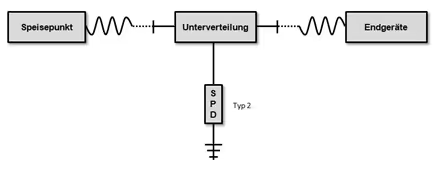
Installation Locations for Surge Protection Devices (SPD):
As of December 14, 2018, surge protection is required for the construction of electrical installations. Selectivity must be ensured: the protective effect of each surge protection stage builds on the previous one. This means the preceding stage reduces the energy content of the overvoltage to prevent thermal overload of the subsequent protection module. The system design and hazard analysis must be carried out by a qualified electrician.
In the case of overhead line supply, Type 1 SPDs may be necessary, as direct lightning strikes must be considered in the hazard analysis. Additional SPDs may be required to ensure adequate protection of the electrical installation.
In building installations, local conditions must be clarified so that the electrical system and required surge protection can be properly planned.

Mobile power distribution systems face changing conditions with each new setup. Detailed planning of the electrical installation often can only be done on-site. Therefore, installing surge protection directly in the mobile distribution box is not always practical. The “Surge Protection Box SPB” from INDU-ELECTRIC was developed specifically for this application. Surge protection can be modularly integrated at the correct point within the installation—directly at the input of the respective sub-distribution. The surge protection integrated in the pre-switching unit (Type 2) meets the requirements for sub-distribution protection.
Feel free to send us an email. We will get back to you as soon as possible.
Visit us at our offices for a personal consultation.
Please use our contact form to send us your request so that we can respond promptly and effectively.