
Your Location & Language

Equipotential bonding has long been an essential part of safe setups in the event and entertainment industry. With the publication of the German standard DIN 15767:2025‑04, its role is now defined even more clearly: equipotential bonding is a safety‑relevant protective measure, and the standard explicitly states that hand‑operated devices such as wing nuts or thumb screws are no longer deemed compliant for this connection.
The reasoning is straightforward: equipotential bonding prevents dangerous voltage differences between simultaneously touchable conductive parts. This is especially critical in temporary installations with mobile equipment, changing supplies and frequent proximity to the public. DIN 15700 describes these operating conditions in detail and derives increased requirements for the clarity and durability of the connection. DIN 15767 builds on these principles and formulates them with deliberate clarity: the equipotential bonding connection must not be unintentionally altered or released during operation. Compliant solutions therefore include either connection boxes for mobile bonding systems in accordance with DIN 15700, or fixed threaded bolts with nuts that can only be released using tools.
This requirement is not a criticism of previously common international practice. Wing nuts have been widely used for many years in touring, broadcast environments and live productions. At the same time, all major wiring codes follow the same safety concept that the German DIN now formulates more explicitly in constructive terms.
The international fundamentals make this clear: IEC 60364‑5‑54 defines the requirements for earthing systems, protective conductors and equipotential bonding, demanding permanent electrical continuity as well as a mechanically suitable and secure execution of the connections. In IEC 60364‑5‑52, particularly in Clause 526 on electrical connections, connections are defined as mechanically and electrically suitable, stable over time and protected against unintentional loosening. These functional requirements are then specified in national codes—now explicitly in Germany through the requirement for tool‑operated connections.
Accordingly, nearly identical principles apply worldwide. In the United Kingdom, BS 7671 and BS 7909 require connections secured against accidental loosening; France demands permanently tight and professionally tightened connections in NF C 15‑100; Austria (OVE E 8101), Switzerland (NIN/SN 411000) and the Netherlands (NEN 1010) use the same functional approach. Outside Europe, this is mirrored by AS/NZS 3000 in Australia and New Zealand, SANS 10142‑1 in South Africa, SS 638 in Singapore and NBR 5410 in Brazil.
Although no global standard explicitly bans wing nuts, virtually all rulebooks require properties that a hand‑operated nut cannot reliably fulfil: defined clamping force, long‑term mechanical stability and clear protection against unintentional loosening. DIN 15767:2025‑04 simply makes these internationally recognised functional requirements more explicitly verifiable.
DIN 15700 provides the technical framework. It ensures that mobile equipotential bonding systems remain reliably functional even during modifications or partial dismantling. Tool‑operated connections are therefore not a formality but an expression of a clearly defined safety principle: any change to the connection must be deliberate and traceable.
Ultimately, the German DIN 15767:2025‑04 creates clear, constructive requirements for a central protective measure. Wing nuts may have been a practical part of international everyday practice, but within the German normative framework, secured, tool‑operated solutions now take precedence—consistently fulfilling the globally recognised safety objective.
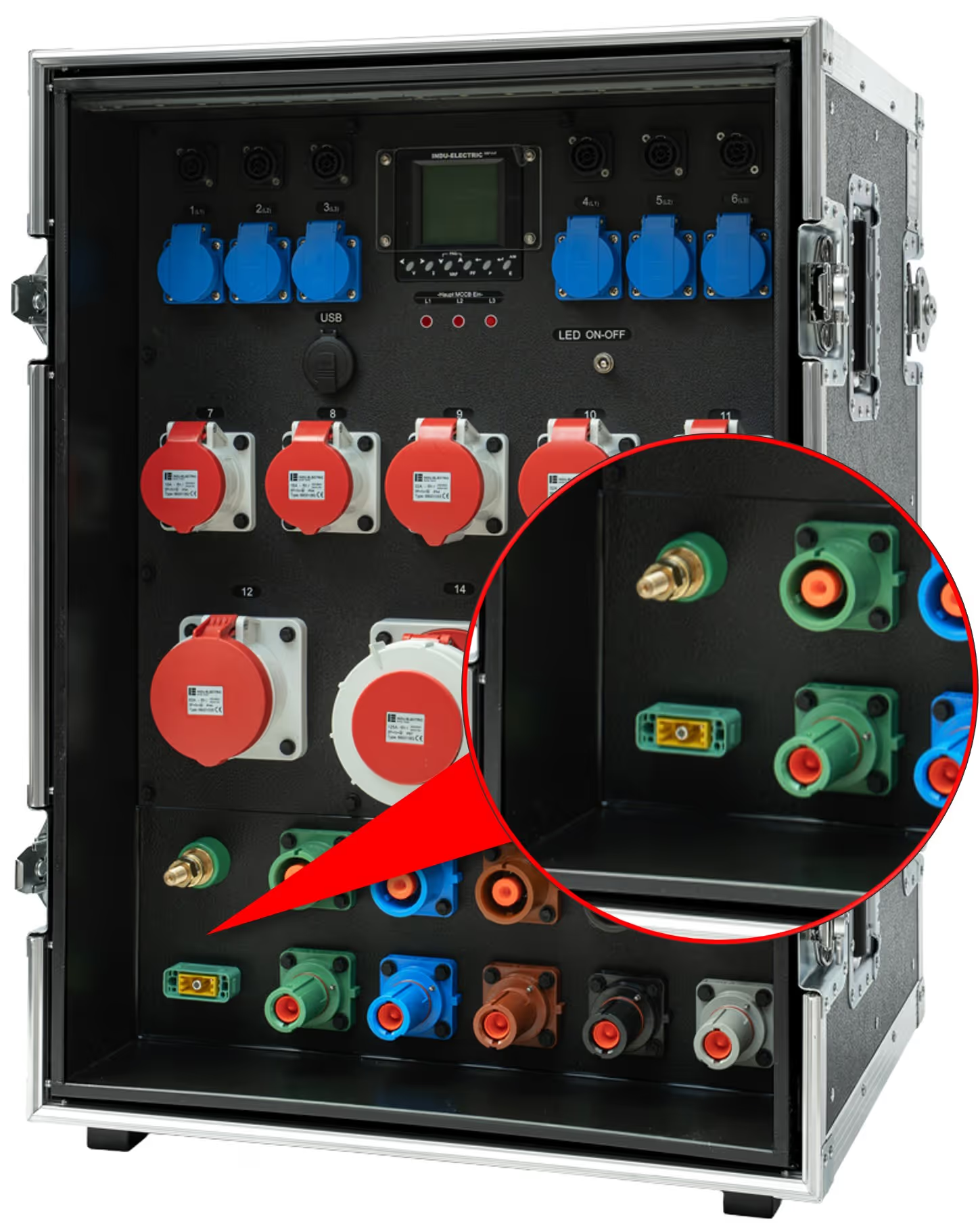
It combines a classic grounding stud with a HAN‑GND connection, thus linking international practice with the clear requirements of the German standard.
The grounding stud deliberately has the same thread as the wing nuts that are commonly used internationally. This means that the use of a wing nut outside the scope of the DIN requirements is fundamentally possible. The decisive difference does not lie in the thread, but in the compliant design: the connection is tool‑based and therefore meets the requirements of DIN 15767 for a secured equipotential bonding.
The grounding stud is complemented by a HAN‑GND connection as a pluggable, clearly secured solution for mobile equipotential bonding systems in accordance with DIN 15700. Users thus benefit from maximum flexibility while at the same time having a clear normative classification.
Especially in international projects, this dual concept creates a practical transition between established working methods and the specific requirements of the German DIN standards – without disruption, without the need to rethink workflows, and without compromising on safety.
Feel free to send us an email. We will get back to you as soon as possible.
Visit us at our offices for a personal consultation.
Please use our contact form to send us your request so that we can respond promptly and effectively.